


At the 2026 PMSA Annual Meeting in New Orleans, Melissa Wagner from Amgen and I led a conversation about pharma’s continued push toward HCP and DTC marketing integration. The setting gave us the perfect metaphor: a jazz performance. Every musician can be excellent on their own, but if they are not listening, communicating, and playing from the same cues, the performance falls flat. The same is true in healthcare marketing. Strong HCP and DTC campaigns can still underperform when they are not synchronized around the treatment decisions that matter most.
Patients and providers experience healthcare as one connected journey, which is why brands need to move from parallel execution to synchronized engagement. That shift requires privacy-safe data science, predictive modeling, deterministic data, and human expertise working together to identify where patient and provider signals overlap. But every organization is at a different stage of that journey, so during the session, we asked attendees how their teams are working today, what they believe could improve, and what still stands in the way.
HCP & DTC Strategy Alignment
We all know treatment decisions aren’t made in isolation. A patient may see an ad, search for information, and prepare to ask their provider about a treatment option. But if the provider isn’t ready to prescribe the brand, momentum will stall. That’s why a synchronized approach is so critical.
When asked about their current degree of alignment between HCP and DTC strategies, just over half of respondents said that there was “some overlap, but mostly independent.”
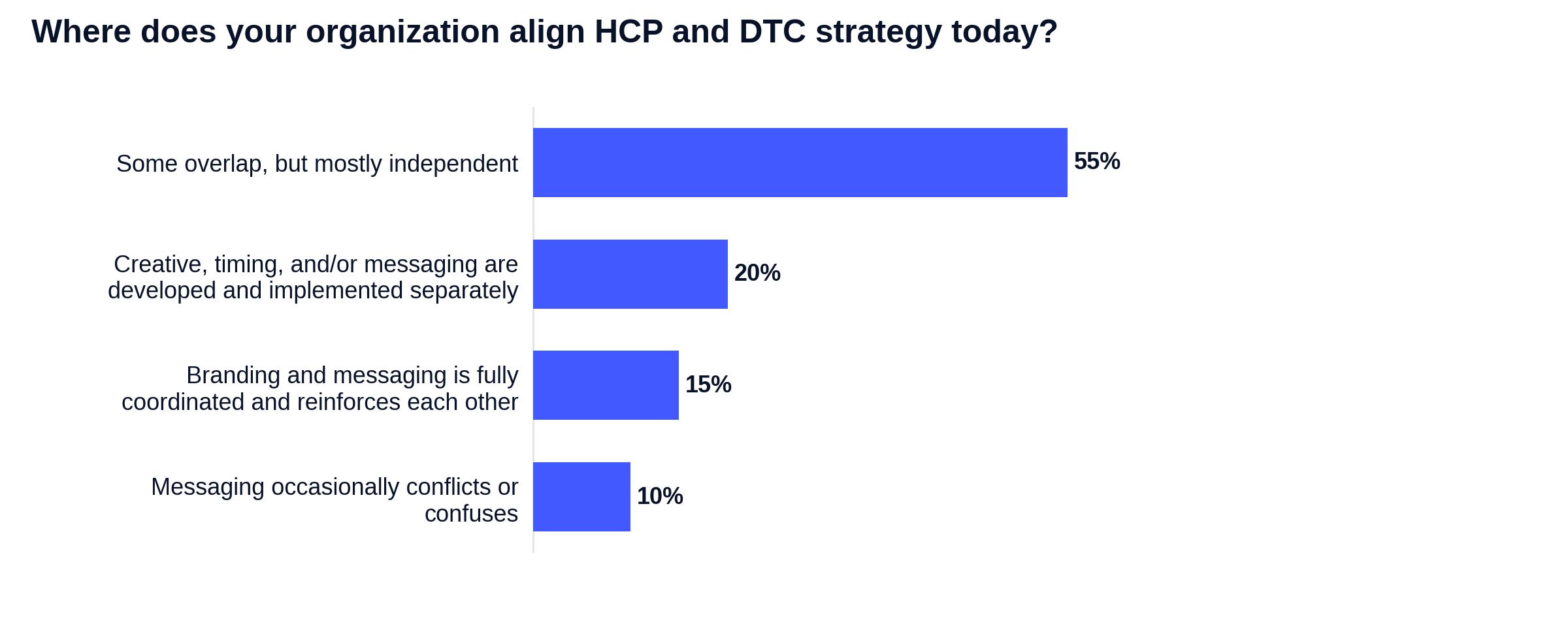
Pharma brands understand the value of integrating DTC and HCP tactics, but find it difficult to push through conflicting priorities, organizational siloes, other operational channels. And the first step to overcoming these challenges it to define alignment more specifically.
DTC and HCP audiences will never see the same brand message as the patient decision to start a medication is different than prescribing the advertised brand. Brands should be asking whether DTC engagement is creating patient readiness at the same time HCP engagement is preparing providers for those conversations. That requires shared journey mapping, better visibility into audience overlap, and a planning model that treats patient and provider engagement as connected parts of a singular journey.
What Improves When HCP and DTC Marketing Align
Integration is often framed as a way to improve efficiency, and that is certainly part of the value. But the larger opportunity is to improve the value and timing of the patient-provider interaction.
For a brand, that interaction is where awareness can become action. A patient may be motivated by DTC messaging, but the next step often depends on whether the provider has the right context, familiarity, and clinical information to support the conversation. If those two sides of the journey are disconnected, brands risk losing momentum at precisely the moment when treatment decisions are being made.
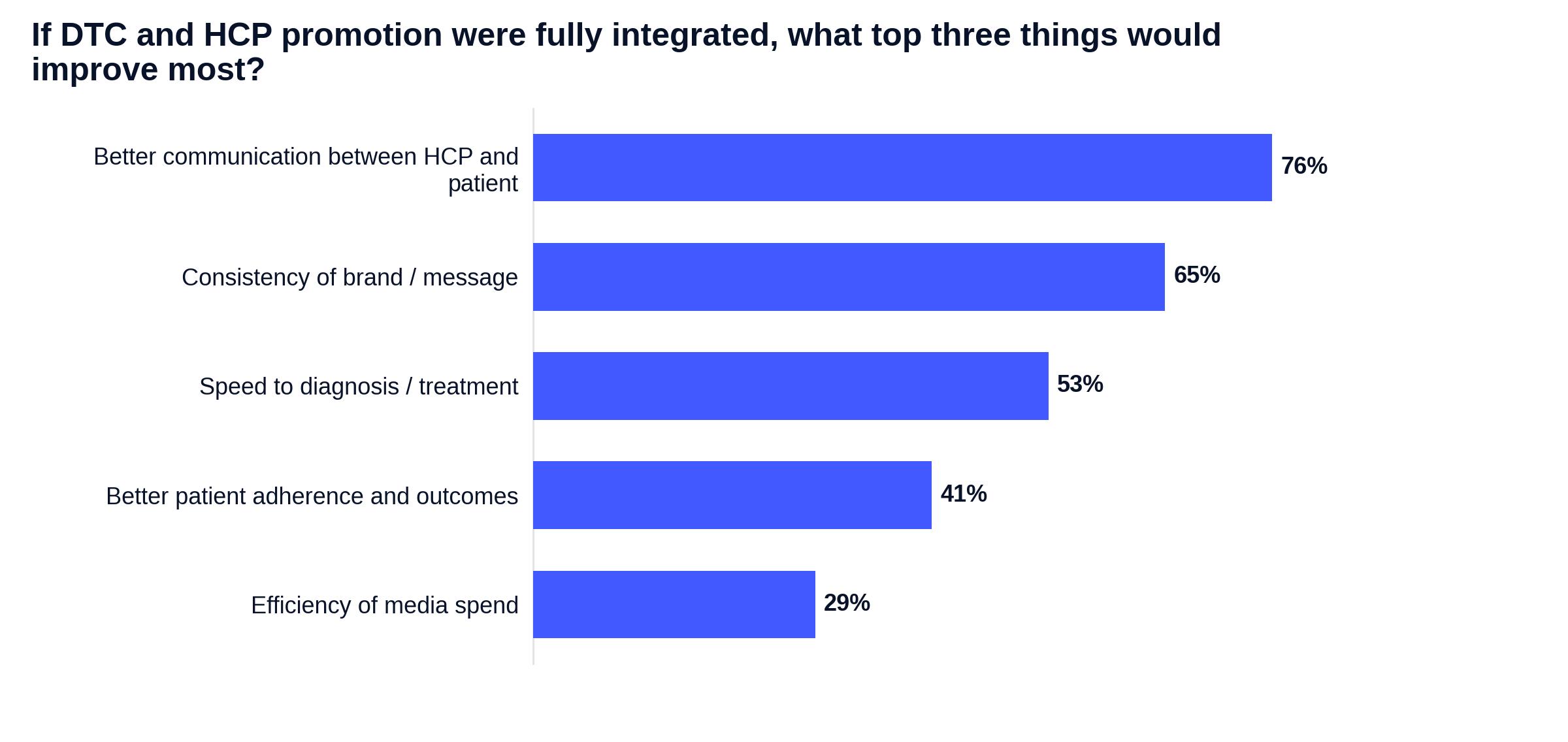
The attendee responses reflected this truth, with 76% selecting “better communication between HCP and patient,” as one of the top three things that would improve with aligned promotion. Interestingly, only 29% ranked “efficiency of media spend” as a ‘top three’ benefit—the focus was on the human moment of connection.
Brands that design audiences and campaigns to make those conversations more likely to happen are the ones that see the impact. That may include aligning patient readiness signals such as related symptoms, co-morbidities, prior therapies, and even misdiagnoses with HCP specialty visit frequency, geography, treatment timing, care windows, and channel preferences.
Most importantly, this can be done in a privacy-safe way. The goal is not to match individuals one-to-one. It is to identify meaningful cohort-level overlap where patient and provider signals are likely to converge. When brands understand where that overlap exists, they can better coordinate timing, messaging, and activation
The Barriers to Alignment
In healthcare marketing, it is easy to assume that data or technology is the main obstacle to HCP and DTC integration. But often, the challenge is organizational.
The attendee responses showed this clearly: with 38% selecting “organizational silos,” as their biggest barrier, followed closely by a lack of shared KPIs. At the same time, no respondents selected “data/measurement limitations.”
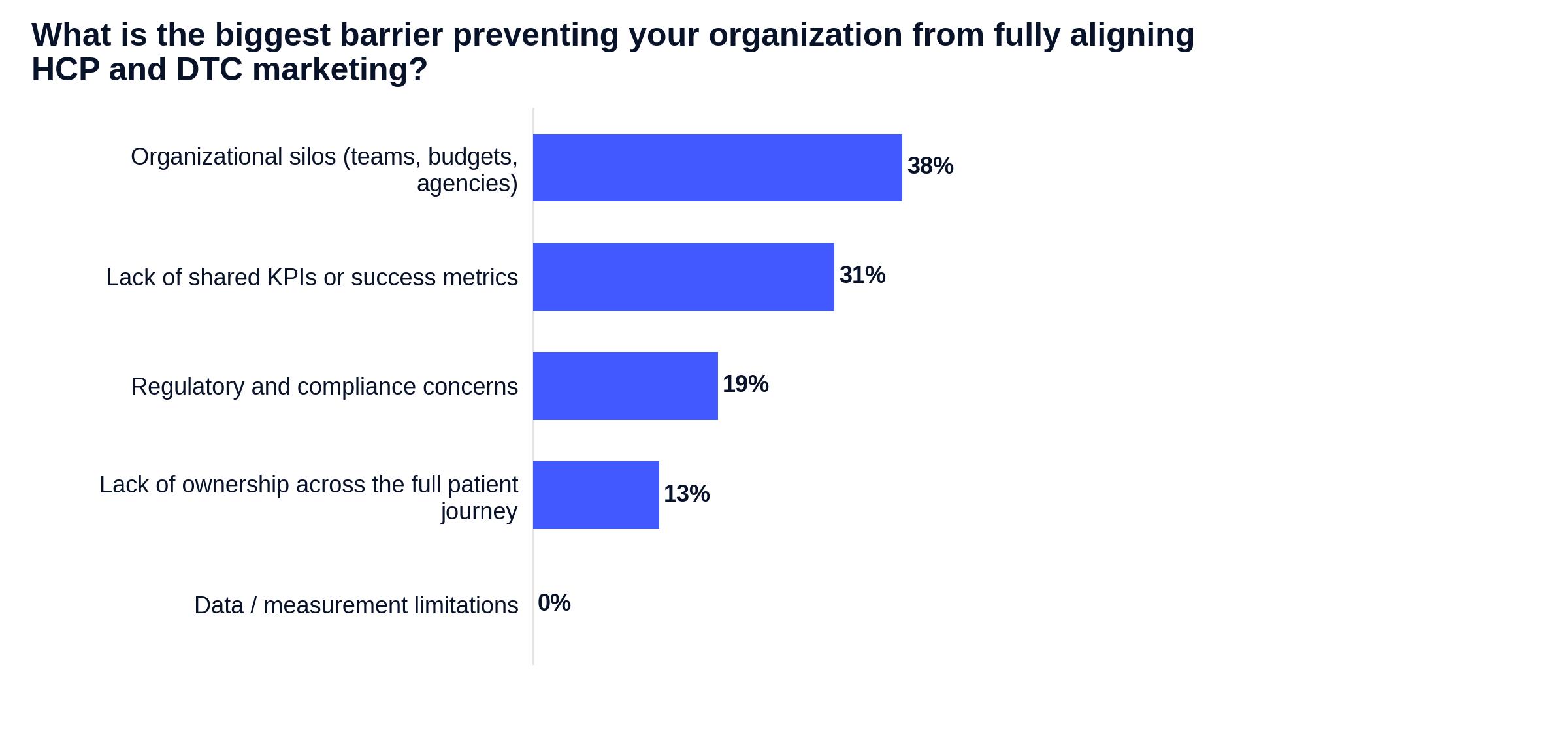
These results suggest that many organizations are wrestling with how to organize around the data they already have, how to agree on what success looks like, and how to make coordinated decisions across functions. But if brands treat alignment as both an analytics challenge and an operating model challenge, data science can help identify overlap, readiness, timing, and opportunity.
One practical next step is to create cross-functional planning moments before campaigns are initiated, not just during post-campaign measurement. HCP, DTC, analytics, media, medical, legal, and agency partners should be aligned early on the patient and provider journey, the role of each audience, and the outcomes that matter most. Without that structure, even strong models can become another disconnected input.
{{quote}}
How Pharma Is Taking Action
As mentioned above, most brands understand the importance of HCP and DTC alignment. But what they are willing and able to change in their planning process to make that alignment real?
“Sharing audience, engagement, or other data between HCP and DTC marketing teams,” was the most common answer from attendees, followed by “creating unified HCP and DTC messaging frameworks,” and “establishing cross-functional working groups.”
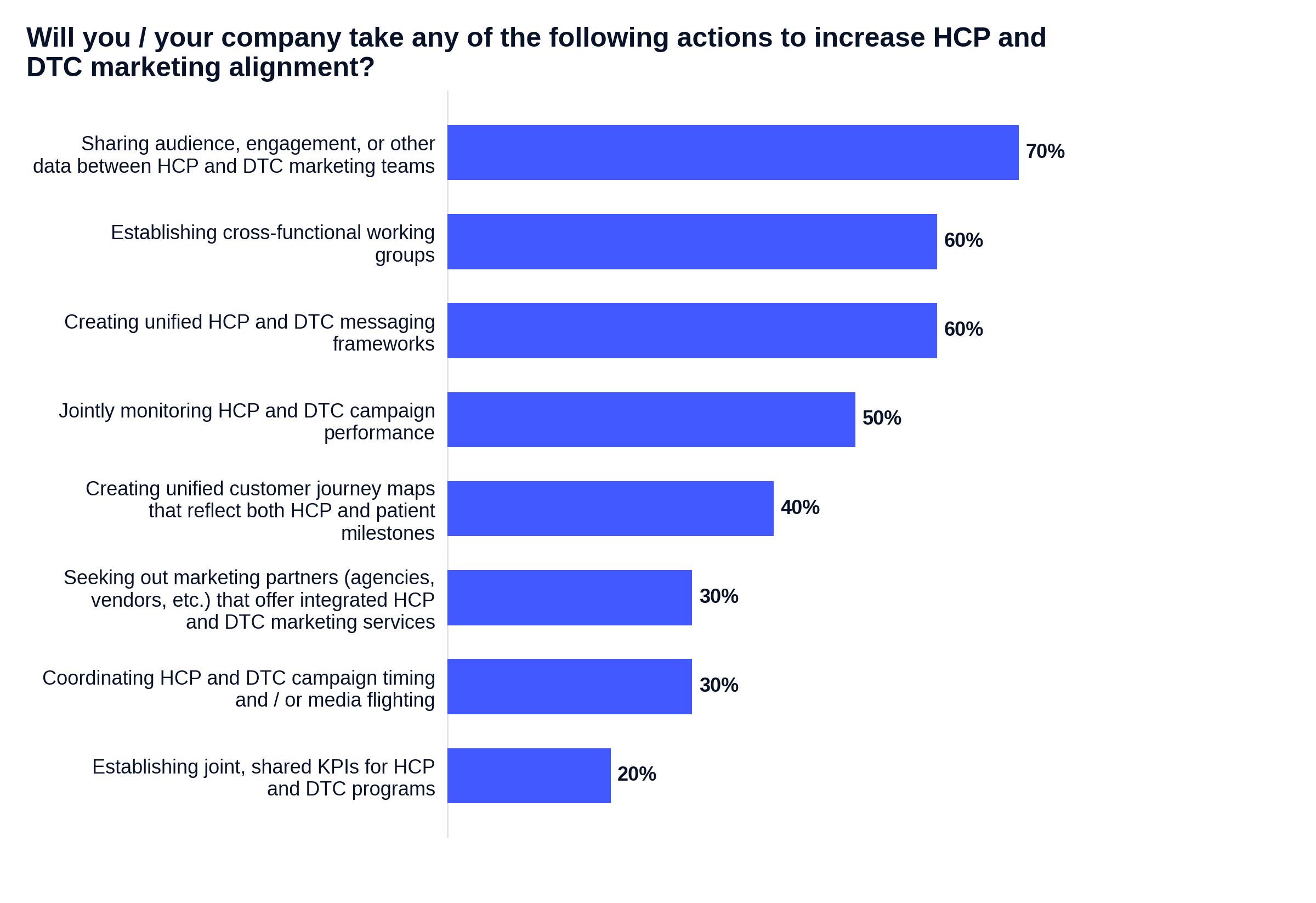
These responses suggest that brands are thinking pragmatically. They aren’t trying to rebuild their organizations overnight, but identifying the foundational steps that make synchronization possible: shared data, shared messaging, shared collaboration, and shared performance visibility.
At the same time, the lower response for shared KPIs is worth paying attention to. If HCP and DTC teams are still measured against separate definitions of success, alignment will always be harder than it needs to be. The more we can connect combined HCP/DTC measurement approaches to shared journey outcomes, the easier it becomes to optimize around the moments that matter most.
The Takeaway: Synchronization is an HCP and DTC Marketing Advantage
Outside the responses themselves, there was another key takeaway from the session: HCP and DTC alignment is no longer just a strategic aspiration. It is becoming a competitive advantage.
The opportunity is to move beyond isolated channel optimization and toward synchronized, patient-centered engagement. That means using AI and predictive analytics to identify readiness and timing, using privacy-safe methods to understand audience overlap, and where possible using privacy compliant, deterministic approaches to reach those populations who can benefit from therapy. Of course, human expertise is required to ensure the strategy is clinically meaningful and actionable.
When HCP and DTC promotion move together, awareness is more likely to become action, patient intent can lead to productive clinical conversations, and favorable health outcomes are more likely to follow.
"Everyone thinks HCP and DTC alignment is a data problem. Our audience told us something different: the data isn't the barrier—the silos are."
